
Interdisciplinary excursion to archaeological sites, museums, galleries and UNESCO locations on the Middle Danube in Austria.
The interdisciplinary excursion to archaeological sites, museums, galleries and UNESCO locations on the Middle Danube in Austria took place from 7th to 10th September 2023. We started with a visit to the MAMUZ museum in Mistelbach in Lower Austria, where we viewed the current exhibition Die Kelten/Kelti. The curator of the exhibition, Peter Trebsche, included significant Latin finds from neighbouring countries. From Slovakia, the Slovak National Museum-Historical Museum lent finds from Bratislava Castle, and the Archaeological Institute of the Slovak Academy of Sciences, v.v.i. provided original finds from a German princely grave from Zohor. Since the bus was full of participants, the interests were diverse. Many were intrigued by the permanent neighbouring exhibition dedicated to the Austrian artist Hermann Nitsch, who was part of the “actionists”, a radical avant-garde movement of the 1960s. Perhaps he is best known for his long-running theatre piece “Mysterium of Orgies”, which showcased the slaughter of animals and religious sacrifices. The MAMUZ museum also includes an archaeological open-air museum in Asparn an der Zaya, which we subsequently visited. The open-air museum was established in the early 1970s, where replicas of prehistoric buildings were constructed for experimental purposes, from the Neolithic to the La Tène period. In October, the park regularly hosts the so-called Night of Celtic Fires (www.mamuz.at). From Asparn, we moved to the Danube to explore Austrian Roman sites inscribed in 2021 together with Slovak sites in Iža near Komárno and Gerulata (Bratislava-Rusovce) in the UNESCO World Heritage List. The first Roman stop in the former province of Noricum was Tulln, a Roman cavalry camp Comagena. The stone castle at the turn of the 1st and 2nd centuries was built by the ala I Commagenorum, which was stationed here until the 3rd century. In late antiquity, Comagena also had a port for the Danube fleet. We visited the archaeological museum and also viewed parts of the fortifications of the Roman camp in situ. By the Danube stands a bronze equestrian statue of Emperor Marcus Aurelius, a copy of the famous one from the Roman Capitol. Finally, we admired the late Roman charnel house from the 13th century near St. Stephen’s Church. The charnel house with a hexadecagonal floor plan was built by a Norman building workshop, commissioned by Friedrich II, the last ruler of the Babenberg dynasty. The interior features reconstructed wall paintings depicting scenes from the Old and New Testament.
The next stop was the auxiliary castle Augustianis/Traismauer and the castle Favianis in Mautern near Krems. Traismauer is known not only for the Vienna, so-called Roman gate Porta principalis dextra, a late antique horseshoe tower and walls, but also for the church of St. Martin, where Prince Pribina was baptized by Archbishop Adalram in 833. In Mautern, we were welcomed by the archaeologist of the Roman Museum, Filip Stabentheim, who prepared a beautiful and interesting underground walk through perfectly preserved Roman walls. He also informed us about new research that was taking place not far from the walls, and we learned interesting facts about the life of St. Severinus, who lived here in the 5th century. The book describing his life – Vita Sancti Severini, by Abbot Eugippius from the 6th century, is an important testimony of life on the border of the Roman Empire at the time of its decline. It also mentions vineyards and the cultivation of vines since the 3rd century. It was a good introduction to the Wachau region, known for its beautiful vineyards on the terraced slopes of the Danube basin.
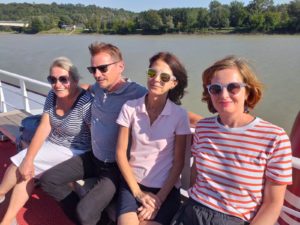
On the second day, we had a meeting with Elke Kellner, representative of ICOM Austria, and we enjoyed a relaxing cruise on the Danube with a tour of the UNESCO site Wachau. By boat, we first stopped in the picturesque town of Dürnstein, where we visited the baroque gem, the Augustinian monastery and the Church of the Assumption of the Virgin Mary. We viewed an exhibition that prompted us to stop and reflect on goodness, beauty and truth, themes that are very relevant today. Some made their way to the ruins of the castle, whose most famous prisoner in the 12th century was the English king Richard the Lionheart. The afternoon cruise continued to the Benedictine monastery in Melk. Along the way, we admired the picturesque towns, terraced vineyards, apricot orchards and castles such as Spitz am Stein and Aggstein. After returning to Krems, we also visited the seat of the Monument Office (Bundesdenkmalamt), which is located in the Gothic castle Gozzoburg. The extensive tour of the beautifully restored building was conducted by archaeologist Brigitte Urabl.
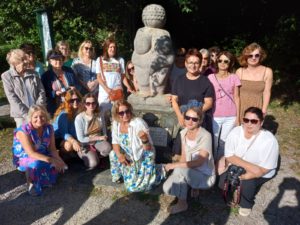
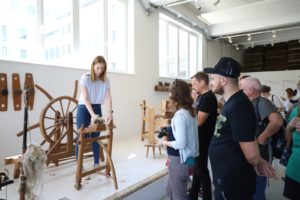
On the third day, Saturday, we said goodbye to medieval Krems and continued our excursion along the left bank of the Danube. After a brief stop in St. Michael (Gothic church and charnel house), we stopped in Willendorf, the site of the discovery of the famous Paleolithic Venus of Willendorf. Just before lunch, we managed to reach Enns, where we visited the Museum Lauriacum. We were warmly welcomed by the museum director Reinhart Harreither, chairman of the Donau-Limes Museen association (http://www.donau-limes.at). The Museum Lauriacum was founded by the Museum Society in 1892. In 2018, a regional exhibition entitled “Return of the Legion” was held here. Enns, formerly Lauriacum, the seat of the second Italic legion, was the only legionary camp in the province of Noricum with a strength of 6000 soldiers. The wealth of the Roman city is also evidenced by the discovery of wall frescoes in the House of the Muses with mythological motifs. In late antiquity, Lauriacum/Lorch was an important center of early Christianity. This is also evidenced by the Gothic basilica of St. Lawrence, within which were found building remains of the Roman prefect and governor, converted in the 5th century into an early Christian sanctuary. Opposite Enns on the left bank of the Danube stands a sad memorial, the site of the former concentration camp Mauthausen, which we also visited. Since 1949, the site has been a national memorial. We spent the rest of the day in Linz, the capital of Upper Austria. The former Roman castle Lentia is now a modern metropolis, famous for the UNESCO Center for Media Art, where an annual festival, Ars Electronica, takes place every autumn. In 1996, the Museum of the Future was opened on the banks of the Danube, attracting huge numbers of visitors. The highlight of the event, which we also experienced, was an unforgettable light and music show by the Danube. On the last, fourth day, we visited the textile museum in Haslach, which documents the tradition of textile production in this area since 1971. The museum truly fascinated us, as in addition to weaving machines, we learned a lot of interesting facts about the cultivation of flax, cotton, silk production and the manufacture of textiles from prehistory to the present day. We concluded the excursion to the Roman camps on the Austrian section of the Danube at an interesting natural phenomenon – the Danube loop in Schlögen. At this point, the Danube creates a horseshoe bend and there is a Roman park. On the way home, we stopped at the Cistercian monastery Heiligenkreuz from the 12th century, just before Vienna.
The Slovak committee of ICOM prepared a four-day excursion, which I hope brought enrichment to each participant. The members of the excursion learned interesting facts not only about archaeological sites, museums and parks, but also gained interesting information about Romanesque, Gothic and Baroque monuments of Lower and Upper Austria, and broadened their horizons with knowledge of contemporary modern visual art. Last but not least, we all had a great experience from the cruise on the Danube, through its most beautiful section in Wachau. The meeting of different professions, colleagues from various institutions, also brought rich discussions and exchanges of views, new insights and impulses that will resonate in our minds for a long time.
Margaréta Musilová