ICOM Austria, ICOM Czech Republic, ICOM Slovakia, ICOM Poland and Museum of King Jan III’s Palace at Wilanów
warmly invites to attend the 2nd Seminar in a cycle
“Planning an extended museum” Museums and Identities
The seminar will be held on 21st – 23rd November
in Museum of King Jan III’s Palace at Wilanów, Warsaw.
Abstract submission deadline: closed
Registration runs from 30 May until October 31
„Museums and landscapes are an essential element of humanity’s physical, natural, social and symbolic environment.” Based on this first sentence from the ICOM Resolution of the 24th ICOM General Conference in Milano 2016 “The Responsibility of Museums Towards Landscape” we want to continue the discussion initiated during the first Seminar in 2017, about the impact museums have and how they react to the landscape that surrounds them, urban or rural. What particular responsibility for protecting this natural heritage and to promote sustainable development do museums have?
But the term „Landscape” also implies other perspectives: How are museums influencing the cultural, social, economic or political identity of the area and society they are situated in? They choose what objects are collected, presented and protected, what stories are told and how. They define what is handed on to future generations. “With Great Power Comes Great Responsibility” to quote Winston Churchill, Theodore Roosevelt and Spider-Man. Therefor we want to question the role of governmental authorities or financial sponsor and how they might influence the presentation or content of exhibitions. How do museums react to financial dependencies or state-ideologies?
Information:
Registration fee: 100 PLN
Fee includes: conference materials, lunch, coffee breaks and dinners Registration via website: www.wilanow-palac.pl
Contact: e-mail: konferencja@muzeum-wilanow.pl
tel: +48 22 544 28 55, +48 22 544 28 54
Place of the Seminar:
Museum of King Jan III’s Palace at Wilanów
Stanisława Kostki Potockiego Street 10/16
02-958 Warsaw
Language:
English
Publication: Selection of lectures will be published
Seminar “Museums and Identities” 21st -23rd November
PROGRAMME (time-frame)
Wednesday, Nov. 21, 2018
10.00-12.00: Registration
12.00-14.00: Opening of the Seminar: Museums facing identities – introduction.
14.00-16.00: Session 1: Perspectives: Different Identities and Missions of Museums
16.00: Coffee break
16.30-18.30: Session 2: Neighbors: Impact of Museums on Cultural Landscapes and Social Networks
18.30: Dinner at Villa Intrata (Historic culinary re-enactment)
Thursday, Nov. 22, 2018
10.00-13.00: Session 3: Politics: Museums in Historical and Contemporary Context
13.00-14.30: Lunch
14.30-16.00: Session 4: Nature: Environmental Impact of Museums
16.00: Coffee break
16.30-18.30: Session 5: Economy: Impact of Museums on Local Development & Financial Sustainability
18.30: Dinner at Villa Intrata (Historic culinary re-enactment)
Friday, Nov. 23, 2018
10.00-13.00: Session 6: European Union: Impact of Museums on European Identity
13.00-14.30: Lunch
14.30-16.00: Discussion, closing of seminar
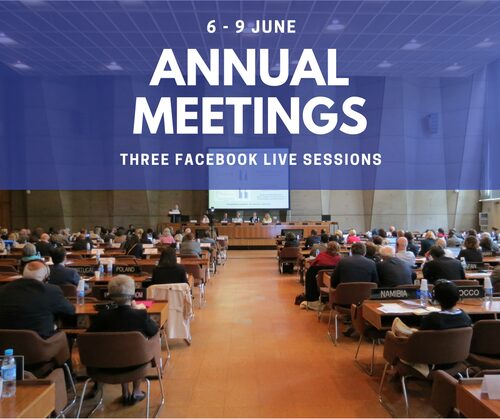
The 2018 ICOM Annual Meetings in Paris, France, are just around the corner. As ICOM keeps expanding its membership across the world, finding new ways of connecting with our members has become our number one priority. For the first time, the Annual Meetings will be available through Facebook Live, making them accessible to the largest number of our members. Three sessions will be retransmitted on real time: the keynote speech, delivered by artist Fred Wilson, the General Assembly, and the vote on the city that will host the 2020 ICOM General Conference. We will also encourage participation through our other social media platforms, Twitter and Instagram, via the hashtag #JuneMeetings.
Meet the keynote: Fred Wilson
Fred Wilson (b. 1954, Bronx, New York) challenges assumptions of history, culture, race, and conventions of display with his work. Since his groundbreaking exhibition Mining the Museum (1992) at the Maryland Historical Society, Wilson has been the subject of many solo exhibitions, including the retrospective Objects and Installations 1979-2000, which was organized by the Center for Art and Visual Culture at the University of Maryland, Baltimore, and traveled to many American museums before closing at the Studio Museum in Harlem. Other solo presentations include So Much Trouble in the World—Believe It or Not! at the Hood Museum of Art, Dartmouth College, Hanover, New Hampshire (2005); Works 2001–2011 at the Cleveland Museum of Art (2012); Local Color at The Studio Museum in Harlem (2013); Black to the Powers of Ten and Wildfire Test Pit at Allen Memorial Art Museum, Oberlin College, Ohio (2016); and Fred Wilson at the Neuberger Museum of Art, Purchase College, New York (2017). In 2003, Wilson represented the United States at the 50th Venice Biennale with the solo exhibition Speak of Me as I Am. His many accolades include the prestigious John D. and Catherine T. MacArthur Foundation’s “Genius” Grant (1999); the Skowhegan Medal for Sculpture (2006).
A variety of opportunities to learn and exchange
ICOM proposes for the upcoming Annual Meetings a variety of interesting workshops which will allow members to better understand our organisation and to shape the way it answers to the challenges the museum community faces today. The Museum Definition, Prospects and Potentials Permanent Committee will hold a workshop focusing exploring different aspects and themes, from current societal trends to new patterns in museum practices. The Department of Programmes of ICOM will welcome members to identify opportunities for capacity building activities in different regions of the world and the ICOM Strategic Plan workshop will present the latest findings from the recent strategic plan survey. In addition, three workshops will be held to meet the permanent committees SAREC and ETHCOM, and the ICOM Working Group on the future of International Committees.
Program
6 June
9:30 – 10:00 am | Welcome coffee
10:00 – 10:30 am | Opening of Annual Meetings
10:30 – 11:30 am | Keynote speech
11:30 am – 12:30 pm | Flash presentations
1:30 – 5:00 pm | Separate meetings of National and International Committees
5:00 – 6:30 pm | Meet the ICOM Standing Committees and working groups
7 June
8:15 – 9:00 am | Welcome coffee, distribution of working documents, registration
9:00 am – 12:30 pm | 84th Advisory Council Meeting
1:30 – 3:00 pm | 84th Advisory Council Meeting
3:30 – 6:30 pm | Workshops
8 June
9:15 – 10:00 am | Welcome coffee, distribution of working documents, registration
10:00 am – 12:00 pm | 33rd General Assembly
2:00 – 5:30 pm | Meetings of Standing Committees, working groups, Boards of Regional Alliances
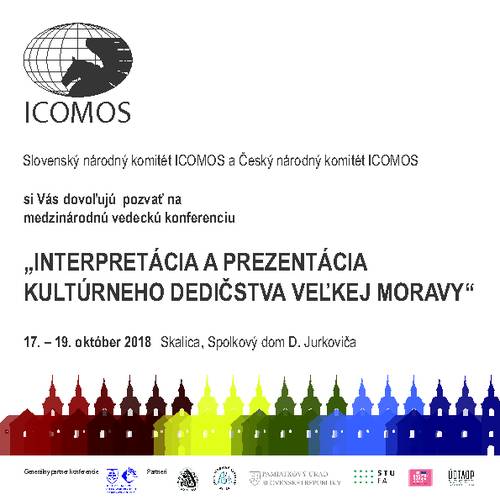
Interpretation and presentation of the cultural heritage of Great Moravia – international scientific conference ICOMOS
In the year of European cultural heritage and the 100th anniversary of the establishment of the 1st Czechoslovak Republic, an international scientific conference ICOMOS Slovakia and ICOMOS Czech Republic will be held with the aim of presenting the latest findings in the research, interpretation, and presentation of the cultural heritage of Great Moravia. The event organized by the Slovak National Committee of ICOMOS and the Czech National Committee of ICOMOS will take place 17th – 19th October 2018 in Skalica (D. Jurkovič Community House). The aim of the conference is to present the latest findings in research, protection, interpretation, and presentation of the shared cultural heritage of Great Moravia and to contribute to the evaluation process for the award of the European Heritage Label. Note, submissions with abstracts of contributions must be sent by 31st May 2018.
Partners from other countries EU: ICOMOS Czech Republic
Contact:
National Committee ICOMOS Slovakia
www.icomos.sk
Gregor Pavel
prof.pavelgregor@gmail.com
National Committee ICOMOS Slovakia
www.icomos.sk
Gregor Pavel
prof.pavelgregor@gmail.com

„The Power of Museums“
Prague, the capital city of the Czech Republic and a beautiful museum under the open sky, will host the 26th General Conference of ICOM from 20th to 28th August 2022.
CALL FOR PAPERS / Call for professional contributions to the conference
Museum professionals from around the world will set new themes and directions for the museum field for at least the next three years.
We will be interested in the strength, position, and opportunities of museums in building a free, democratic, and educated society; the responses of museums to the challenges and needs of the 21st century; the ability to cope with the impacts of the COVID-19 pandemic, both social and economic.
During ICOM Prague 2022, the results of the search for a new definition of a museum will be presented.

ICOM SLOVAKIA in collaboration with ICOM CZECH REPUBLIC, ICOM AUSTRIA
organises in Bratislava an international seminar
6th – 7th November 2019
Revolution: gentle x digital – digital and social media in museums 30 years after
Venue: Winter Riding Hall of Bratislava Castle, Slovak National Gallery
In 2019, we commemorate thirty years since the fall of the Iron Curtain, which also brought changes in the paradigm of viewing information and its significance. The freedom gained after 1989 was perceived in the states of the former socialist bloc mainly as freedom of speech and sharing information.
Museums, which are not only guardians of objects but also of information, gradually began to use digital technologies for their preservation and dissemination, changing the way the public seeks and uses information – including about cultural heritage.
How do museums reflect this reality? What tools for meaningful communication exist for museums through digital technologies? How to connect the virtual world with the world of museum exhibitions and displays, where the main focus is on conveying a real collection item? Do museums have effective strategies set up to lead from the physical museum to the so-called augmented museum, which minimizes geographical, temporal, and financial barriers by making collections and information available online?
On the other hand, hyperconnectivity through social networks brings a new phenomenon: instant reaction, abbreviated expression, hidden identity, thus opening up space for the misuse of published information leading to misinterpretations and distortion of historical facts. Can museums survive in such an environment? What is their role in the fight against so-called fake news and in preserving the democratic system?